Open enrollment for 2026 health coverage is underway right now, typically running from November 1, 2025, through mid-January 2026 for most marketplaces and employers. For employees with limited English proficiency (LEP), this is a critical but often confusing period. Language barriers during open enrollment can lead to poor plan choices, missed deadlines, compliance violations, and health inequities. The good news: even late in the enrollment window, practical steps can improve access and reduce risk. This guide provides an immediate, actionable translation checklist to help HR, benefits, and compliance teams strengthen language access for LEP employees during the current 2026 open enrollment period, and reduce liability under ACA Section 1557, Title VI, and CMS language access requirements.
What You Can Still Fix During This Open Enrollment
Open enrollment may have already started in your organization, but there is still time to take meaningful action to improve language access and compliance. You do not need perfect, long-term solutions; what matters now is identifying the highest-impact documents and communications that LEP employees are struggling with this week, and improving them before the enrollment window closes. Even small improvements—translating three to five vital documents, updating tagline notices, training staff on how to connect LEP employees with interpreters, and creating a simple FAQ in top languages can reduce confusion, increase enrollment accuracy, and protect your organization from regulatory exposure.
Research shows that LEP individuals face significant barriers when navigating healthcare decisions. When open enrollment materials remain in English only, LEP employees are more likely to skip enrollment, select inappropriate plans, miss critical deadlines, or rely on family members for interpretation, which introduces medical errors and privacy risks. By acting now, you address the immediate pain points LEP employees face today, demonstrate compliance intent, and build the groundwork for a more robust approach in 2027.
Know Your LEP Employees and Top Languages (Fast Assessment)
Before investing time and resources, confirm which languages matter most in your workforce. You do not need a perfect, months-long demographic study; instead, use immediate signals from your current open enrollment window to guide quick decisions.
Fast assessment methods:
Ask HR and local managers: Which employees or their family members have contacted HR or benefits with questions in a language other than English, or have indicated difficulty understanding benefits materials?
Review current call center logs: During open enrollment, call volume often spikes. Note which languages are driving support requests. Spanish, Vietnamese, Mandarin Chinese, Korean, Tagalog, Russian, and Arabic are among the top LEP languages in the U.S.. Your workforce may differ, so look to local data first.
Check existing language preference data: If your HR system or benefits platform captures employee language preference, pull a quick report. This can reveal how many employees have indicated a non-English language.
Prioritize the top 2–5 languages: You do not have time to support all languages this cycle. Focus on the languages spoken by the largest or most at-risk groups in your workforce. If 80% of your LEP-flagged employees speak Spanish, prioritize Spanish first; if you have significant Vietnamese or Mandarin speakers, add those next.
This quick assessment takes hours, not weeks. The goal is good enough quickly, not perfect data. Use what you learn to rank your translation priorities for the rest of this checklist.
Prioritize the Documents That Matter Most During Open Enrollment
Not all documents are equally important right now. Open enrollment materials are dense and complex; focusing your limited translation and improvement resources on the highest-impact documents ensures LEP employees get the help they need before the deadline.
Vital and high-impact documents employees are using right now:
Benefits guides and plan comparisons: These explain coverage, costs, and how plans differ. Employees rely on them to make choices.
Summary of Benefits and Coverage (SBC) and Summary Plan Descriptions (SPD): These define coverage limits, exclusions, and employee rights. SBCs must be "presented in a culturally and linguistically appropriate manner" if at least 10% of the population in your county is literate only in a non-English language. SPDs must include a prominent notice in applicable non-English languages explaining how to get language assistance if your plan has 500+ participants literate only in that language.
How-to-enroll instructions and deadlines: Simple, clear instructions on where to enroll and when the deadline is. If LEP employees do not understand the process or miss the deadline, they lose coverage.
Plan change summaries for 2026: Explain what is new, what changed, and what it means for employees.
Important notices about rights, appeals, and language assistance: Notices about the right to appeal, the right to request interpretation, and how to access language services. These are legally required but often overlooked.
Rank your documents into three tiers:
"Translate or clean up now" (highest priority): SBC summaries, how-to-enroll guides, plan change highlights, and language assistance notices. These documents directly affect whether LEP employees can enroll and understand their choices.
"Simplify now in English + quick LEP support" (medium priority): Longer benefits guides, FAQs, and educational materials. If full translation is not feasible, simplify the English version (shorter sentences, clear headings, fewer jargon terms) and ensure interpreters or bilingual staff can explain key points by phone.
"Park for after this OE but log for next cycle" (lower priority): Detailed reference materials, archived documents, or materials used less frequently. Document what you did not have time to translate so that next cycle starts stronger.
Section 1557 of the Affordable Care Act requires covered entities to provide language assistance services and translated vital documents for meaningful access by LEP individuals. If you are a health plan, employer offering group health coverage, or a TPA administering benefits, you must ensure LEP employees understand their coverage options and have access to their rights. Datagain Connect specializes in identifying and translating these critical materials quickly, even during active open enrollment. Our team can review your priority documents and advise which need immediate translation to meet Section 1557 and CMS expectations, and which can be addressed after the deadline. Reach out with your specific materials and deadlines, and we can help you triage.
Quick Translation Strategy: AI vs. Human During Active Open Enrollment
Speed matters, but accuracy and compliance matter more. During a tight open enrollment window, many organizations face pressure to translate documents fast—sometimes too fast. Understanding when AI translation is acceptable and when human expertise is required can help you avoid costly mistakes.
For rights-heavy, legal, and coverage-defining materials:
SPDs, SBCs, notices about rights and appeals, eligibility and coverage determination letters, and employee handbooks must be translated by qualified human translators and reviewed by bilingual experts. These documents carry legal weight and direct employee choices; errors can expose your organization to complaints, regulatory audits, and discrimination claims. LEP employees relying on these materials must understand them accurately. AI-only translation of these documents during open enrollment significantly increases risk and does not meet the standard of "meaningful access" required by Section 1557.
For secondary content:
Simple reminders, short FAQs with basic information, quick tips, and internal communication messages can be drafted using AI translation tools as a starting point, but must have skilled human review before publishing. A bilingual employee, qualified translator, or language services partner should review all AI translations to catch errors, confirm tone, and verify that medical or benefits terminology is accurate. This hybrid approach (AI draft + human review) can save time while maintaining quality.
Why AI-only translation is risky during open enrollment:
AI lacks the medical and legal terminology knowledge required for benefits documents
Errors in coverage descriptions, eligibility rules, or rights notices can lead to LEP employees making wrong decisions
If a complaint arises about lack of meaningful access, AI-only translation will not demonstrate good-faith compliance effort
Telemedicine, call center, and benefits portal interactions are high-stakes; inaccuracy damages trust and outcomes
How to move fast with human quality: Datagain Connect can provide urgent translation services with AI-assisted drafting and professional human review, prioritizing your highest-impact documents first. We understand open enrollment timelines and can deliver compliant translations within days, not weeks. Contact us to discuss your specific documents and deadline.
"Now Until Deadline" Translation Checklist for LEP Employees
Here is a concise, action-oriented checklist framed explicitly as work you can do today through your open enrollment deadline (typically mid-January 2026 for most states, or earlier if your employer has a shorter window). Use this to track progress and ensure you do not miss key steps.
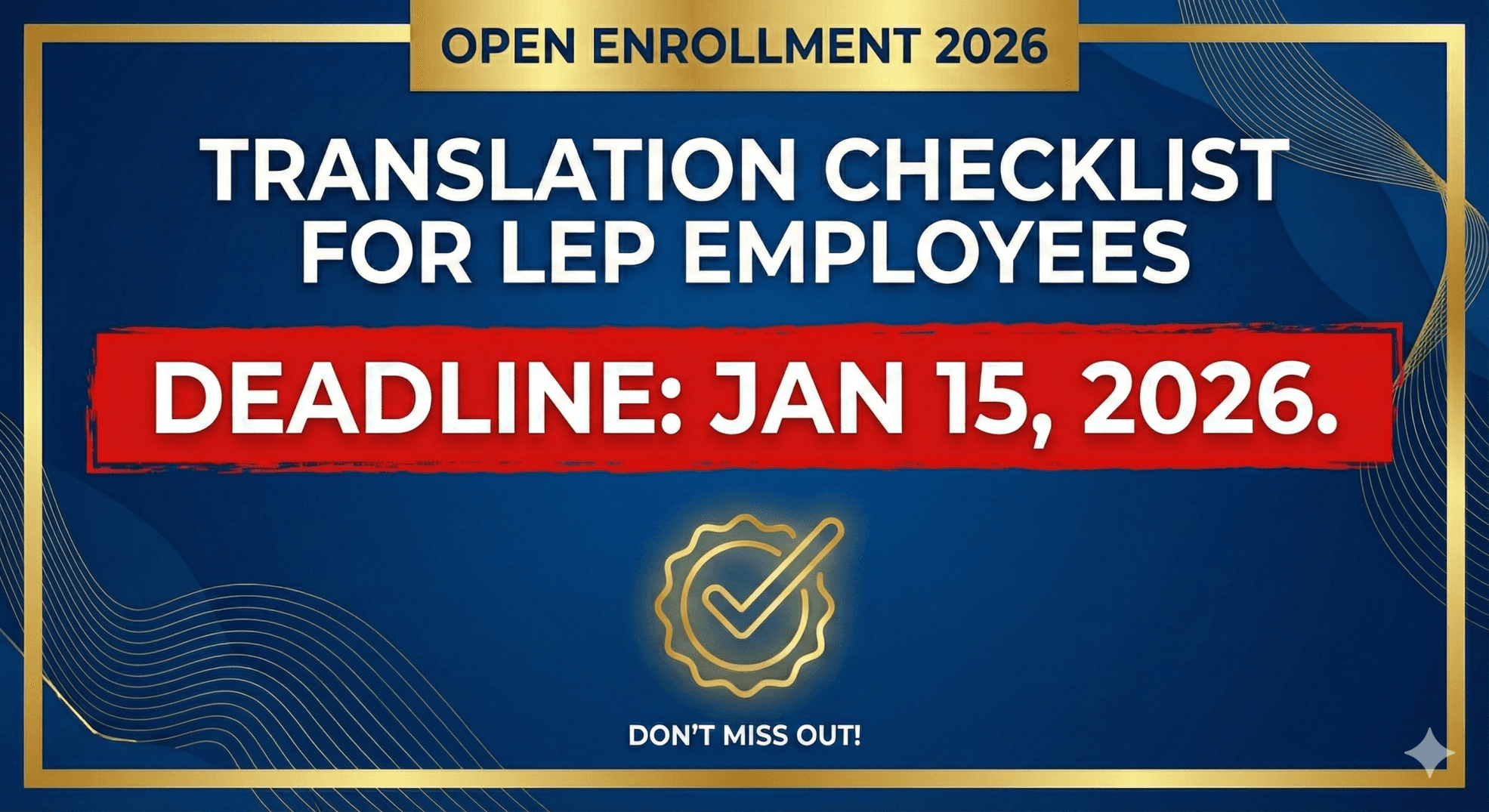
"Now Until Deadline" Translation Checklist for Open Enrollment 2026 – A step-by-step guide for HR and benefits teams to prioritize and complete translation and language access improvements during the active enrollment window
Step 1: Confirm your open enrollment end date and internal deadlines
Note the final enrollment date for your state (most states: January 15, 2026; some extend to January 31, 2026; check your state exchange or employer-specific deadline)
Identify any internal deadlines for when enrollment must close, plan changes must be finalized, or communications must be sent
Step 2: Identify your top LEP languages from available signals
Conduct the fast assessment described above (call center logs, manager feedback, language preference data)
Choose your top 2–5 languages to focus on for this open enrollment
Step 3: Select 3–5 must-fix documents to translate or improve now
Review the documents listed in "Prioritize the Documents That Matter Most" section
Pick the three to five that will have the biggest impact on LEP employee understanding and compliance (usually: SBC summary, how-to-enroll guide, plan change summary, language assistance notice, and one FAQ)
Step 4: Engage Datagain Connect or another qualified translation partner for priority documents
Provide your selected documents and deadline
Request translation services that include human review and compliance quality assurance
Specify delivery date (aim for at least 2–3 weeks before your deadline to allow review and correction)
Step 5: Add or update language access notices and taglines
Add Section 1557 tagline notices to all significant communications and your website, informing employees that language assistance is available free of charge
Include notice in at least your top 2–5 LEP languages, with clear contact information for how to request help
Post notices in "conspicuous physical locations where you interact with employees" (break rooms, benefits fairs, HR office) and prominently on your website and benefits portal
Step 6: Provide front-line HR and call center staff with a simple script
Create a one-page guide for HR and call center staff explaining: "How to help an LEP employee during open enrollment"
Include: how to identify a language need, how to connect the employee with an interpreter, what to say, and what not to do (e.g., do not assume a family member can interpret, as this violates privacy)
Train staff in 15 minutes using this script
Step 7: Create or update a short, plain-language FAQ for LEP employees
Write 5–7 simple Q&As addressing common open enrollment questions: "What is open enrollment?", "How do I choose a plan?", "When is the deadline?", "How can I get help in my language?"
Keep answers to 2–3 sentences each
Have your translation partner translate this FAQ into your top languages
Make the FAQ available on your website, email it to employees, and print copies to post
Step 8: Log what you translated, supported, and by whom
Create a simple record: date, document name, languages translated, translator/vendor name, who reviewed it, where it was posted/shared
This log serves as an audit trail if questions arise about what language access support you provided during open enrollment
Include this log in your open enrollment file for compliance records
Supporting LEP Employees Across Channels During Active Enrollment
Language access is not just about documents; it is about creating multiple pathways for LEP employees to get help and understand their choices. Even late in the open enrollment window, these actions can reduce confusion and prevent call center spikes.
Update website and benefits portal:
Post translated PDFs of priority documents (SBC, how-to-enroll, FAQ) in a clearly labeled "Languages" or "Multilingual Resources" section
Ensure the website clearly states: "Free interpretation and translation services available in [list languages]. Call [number] or visit [page]"
If your benefits portal allows it, enable language selection so employees can view key pages in their preferred language
Notify HR and call center that translated materials are available:
Send a brief announcement to all front-line staff: "We now have benefits materials available in [languages]. If an employee requests help, here is where to direct them"
Remind staff how to conference in an interpreter if an employee calls with a question in a non-English language
Post the tagline notice in the break room and office, so employees see that help is available
Send one clear, simple reminder message in multiple languages:
Craft a one-paragraph, plain-language message: "Open enrollment ends [date]. If you need help understanding your health plan options, we can provide free help in your language. Call [number] or visit [page]."
Translate this message into your top 2–5 languages
Send it via email, post it on the portal, and consider a text message or posting in a physical location where employees gather
Timing: Send this reminder 2–3 weeks before the deadline and again 1 week before the deadline
Support by phone and in person:
Ensure your HR and call center team knows how to connect LEP employees with qualified interpreters (whether in-house, by phone, or by video)
Make it easy for employees to request interpretation: "Press 1 for English. For assistance in another language, say your language name or press 2."
Have bilingual HR staff or a language services partner available during key open enrollment events or hours to speak directly with LEP employees
These steps take hours to implement but can dramatically reduce calls from confused LEP employees late in the enrollment window and improve enrollment accuracy.
Minimal Documentation You Should Capture Now
Even if your organization has never done formal language access planning, start a simple record now. This documentation protects you by demonstrating good-faith compliance efforts.
Lean "do it now" documentation list:
Which documents you translated during this open enrollment window: List each document name, language(s) translated, and final delivery date
Which languages you supported: Note the top 2–5 languages and why you chose them (e.g., "Spanish: 40% of LEP-flagged employees; Vietnamese: 15%; Mandarin: 12%")
Who translated or reviewed them: Vendor name (e.g., "Datagain Connect"), translator names, or in-house bilingual staff who reviewed the work
Where and how you made them available: Posted on website, emailed to employees, printed in HR office, shared at benefits fair
Date submitted and deadline met: Track that you delivered on time
Any feedback from employees: Note any questions or corrections employees reported about the translated materials
This documentation takes 30 minutes to compile but provides a critical audit trail if your compliance is ever questioned. If an LEP employee or regulator asks, "What language support did you provide during the 2026 open enrollment?", this record proves you acted in good faith and took reasonable steps.
Common Last-Minute Mistakes to Avoid (Even Now)
As the open enrollment deadline approaches, pressure rises and corners are tempting to cut. Here are the mistakes most commonly made even late in the enrollment window—and what to do instead.
Mistake 1: Ignoring LEP issues because "it is too late this year"
Why it is a problem: Section 1557 and Title VI do not have a "too late" exemption. If your organization did not provide meaningful access to LEP employees, it is a compliance violation, regardless of how close the deadline is.
What to do instead: Act now. Identify the top 2–3 documents, get them translated by a qualified partner (even if translated documents are not perfect), and make them available. Something is better than nothing. Datagain Connect can prioritize urgent translations.
Mistake 2: Publishing AI-only translations for SPDs, SBCs, or rights notices
Why it is a problem: These legal, coverage-defining documents must be accurate. AI errors (especially with medical and legal terminology) can mislead LEP employees and expose you to complaints and audit findings.
What to do instead: Use qualified human translators and bilingual review for these vital documents. If speed is critical, use AI as a draft and have a bilingual expert review it before posting. This takes 1–2 days, not weeks.
Mistake 3: Sharing translated PDFs but not telling employees they exist
Why it is a problem: If employees do not know translated materials are available, they still cannot access them. You have done the work but not closed the communication loop.
What to do instead: Actively promote the translated materials. Send an email announcement, post tagline notices, update your website, and train staff to mention them when LEP employees call.
Mistake 4: Forgetting to update language assistance notices and taglines on new or revised materials
Why it is a problem: Section 1557 requires that all significant communications include language assistance taglines. If you translate a new notice or update an old one, the translated tagline must appear too.
What to do instead: When you post translated documents or materials, automatically include the Section 1557-compliant tagline in the primary document and in each translation. Make it a checklist item: "Is the language assistance tagline in this document?"
Mistake 5: Not training staff on how to help LEP employees
Why it is a problem: Your benefits team may not know how to respond if an LEP employee calls or asks for help. Unclear responses can frustrate the employee and send them away without getting the support they need.
What to do instead: Spend 15 minutes providing your HR, call center, and benefits staff with a simple script: "I can help. Do you need assistance in another language? Let me conference in an interpreter." Make it routine, not awkward.
Short FAQ – LEP Translation During the Current Open Enrollment
Q: Is it worth translating benefits materials if open enrollment is already underway?
A: Yes. Even if open enrollment has started, LEP employees are still making choices through the deadline (mid-January 2026 for most states). Providing translated materials and language assistance now reduces errors, improves completion rates, and demonstrates compliance with Section 1557 and CMS expectations. Even if your translation is not finished until mid-to-late enrollment, it still helps employees who have not yet made a choice.
Q: Which documents should we translate first when time is short?
A: Prioritize: (1) SBC or plan summary, (2) how-to-enroll guide, (3) language assistance notice/tagline, (4) plan change summary for 2026, and (5) one short FAQ. These five documents address the most critical pain points: understanding plans, understanding the process, knowing help is available, understanding what is new, and answering quick questions. Datagain Connect can help you triage and deliver these in priority order.
Q: Can we rely on AI translation during open enrollment if we are under deadline?
A: Not for vital documents. AI can draft translations of SPDs, SBCs, and rights notices, but these must be reviewed and corrected by qualified human translators before posting. For secondary materials (short tips, simple FAQs, reminders), AI with human review is acceptable. The key is: if the document affects legal rights or coverage choices, use humans. If it is informational, AI + review can work.
Q: How can we quickly let LEP employees know that translated materials are available?
A: Use multiple channels: email announcement, website update with tagline, print notice in break room, mention in call center scripts, and social media (if your organization uses it). Send the message 2–3 weeks before the deadline and again 1 week before. Keep it simple: "We have [document name] in [languages]. Call [number] for help."
Q: Does ERISA require us to translate SPDs for non-English speakers?
A: ERISA does not require full translation of SPDs, but if your plan has at least 500 participants literate only in the same non-English language, you must include a prominent notice in that language explaining how to get assistance. Additionally, under ACA Section 1557 and Title VI, you must provide meaningful access to LEP individuals, which may include translations or oral interpretation. When in doubt, provide translation or robust interpretation services.
Q: What happens if we miss the open enrollment deadline?
A: If employees miss the deadline without good cause, they generally cannot enroll or change plans until the next open enrollment (2027) or unless they experience a qualifying life event (marriage, birth, job loss, etc.). However, LEP employees who lacked language access may have a basis to claim they were wrongly excluded. By providing language support now, you reduce this risk and demonstrate equity. If an employee later claims they missed the deadline due to language barriers, documentation of your translation and interpretation efforts will protect you.
When to Bring in Datagain Connect During This Open Enrollment Window
Even mid-enrollment, specialized language access support can make a difference. Rather than struggling alone with translation, vendor selection, or compliance questions, partnering with an expert focused on benefit guide translation and open enrollment language access can accelerate your progress and ensure quality.
Bring in Datagain Connect if:
You need urgent translations of 3–5 priority documents and do not have in-house bilingual translators
You want to triage documents to determine which should be translated first and which can wait until after open enrollment
You need SBC, SPD, or other legal/coverage documents translated with compliance review and no risk of AI-only errors
Your call center or HR team is experiencing a spike in calls from LEP employees and you need interpretation services or chat support
You want to ensure your tagline notices and language assistance materials meet Section 1557 requirements
You need cultural and linguistic review to confirm that translated materials resonate with your workforce's specific communities
How Datagain Connect can help during this window:
Rapid triage: We review your current materials and advise which 3–5 documents will have the most impact if translated quickly
Urgent translation: We prioritize your documents and deliver turnaround times suited to your deadline (2–3 weeks for standard, faster for expedited)
Compliance assurance: All translations include professional human review and Section 1557/Title VI/CMS compliance validation
Staff training: We can brief your HR and call center team on language access best practices and compliance obligations
Documentation: We provide you with a record of what was translated, who did the work, and where materials were deployed—audit-ready documentation for compliance files
Reach out now with your specific documents, deadline, and LEP languages. The sooner you contact us, the sooner we can prioritize your materials and keep your open enrollment on track.
Get Immediate Help With Open Enrollment 2026 Translation
The open enrollment window is active, and the deadline is closer than you think. If your organization has LEP employees and you have not yet addressed translation and language access for benefits materials, now is the time to act.
Use the contact form below to reach Datagain Connect for immediate support:
Share the following information:
Which benefits documents are causing the most confusion now (from calls, feedback, or complaints)
Which languages you need help with (your top 2–5 LEP languages)
When your open enrollment window closes (your deadline)
Our team specializes in benefit guide translation services and understands open enrollment timelines. We can quickly triage your materials, prioritize urgent translations, and ensure your organization is meeting Section 1557 and CMS language access expectations—even if the deadline is weeks away.
Do not wait until last week. Contact us today through the form below. Datagain Connect is ready to help you deliver compliant, clear, and culturally appropriate language access for your LEP employees during this critical open enrollment period and set the stage for a stronger, more equitable approach in 2027.
Ready to improve language access for your LEP employees during open enrollment 2026?
Reach out to Datagain Connect for specialized benefit guide translation services, open enrollment support, and Section 1557 compliance assurance. Use the contact form below to get started, our team responds within 24 hours.