

Website & App Localization Services
Real-time certified interpretation for healthcare, legal services, business meetings, and events. HIPAA-compliant, court-certified interpreters. Same-day appointments available. Simultaneous, consecutive, remote and phone interpretation.
We handle your localization directly within your source files. You send us the technical formats (HTML, JSON, XML, .strings), and we return them ready to deploy. The code tags remain locked, and the design stays intact.
We utilize a Human-in-the-Loop (HITL) hybrid model. Our advanced Neural Machine Translation (NMT) engines handle the heavy lifting for volume and consistency, while native subject-matter experts review, refine, and certify the final output. This approach reduces your turnaround time by 40% and lowers costs, without sacrificing linguistic quality.
How We Handle Website Localization
Launching a multilingual website is a technical task, not just a linguistic one. We manage the three specific layers required for a functional global site:

On-Page Content & UI
We translate the visible text while respecting character limits. If a German word is 30% longer than the English one, we adjust the phrasing to ensure it fits your navigation bar and buttons, rather than breaking the layout.
Multilingual SEO
Direct translation fails here. We research high-volume keywords in the target market (e.g., what users in Japan actually type into Google) and adapt your content to match.
Meta Tags & Descriptions: Translated and optimized for local click-through rates.
Hreflang Tags: We advise on tagging to ensure search engines serve the correct language to the correct user.
URL Structure: We provide guidance on localized sub-directories versus sub-domains.
CMS Compatibility
We work with your existing infrastructure. Whether you are on WordPress, Shopify, Drupal, Sitecore, AEM, or a custom stack, we work with the export files your system generates, no manual copy-pasting required.
Integration Options
Manual file transfers work for small projects, but they don't scale. We offer three tiers of integration to fit your current infrastructure, ranging from simple plugins to full enterprise automation.
Tier 1: Pre-Built CMS Connectors (Plug-and-Play)
Best for: Marketing teams using standard platforms who want to avoid IT involvement.
We plug directly into your Content Management System (CMS). You select the pages you want translated inside your own dashboard, click "Send," and the translated pages appear back in your CMS automatically. No files to download, no code to touch.
Supported Platforms:
WordPress (WPML), Drupal (TMGMT), Shopify, Magento, BigCommerce.
Benefit:
Marketing managers can launch new languages without waiting for developer assistance.
We integrate directly with your version control systems. When your developers push a new feature to the repository, our system detects the new strings, translates them, and pushes them back as a "Pull Request" for your team to merge.
Supported Platforms:
GitHub, GitLab, Bitbucket, Azure DevOps.
Benefit:
Continuous Localization. Your app is translated simultaneously with development, preventing "localization lag" at release time.
Tier 2: Developer-Centric Automation (CI/CD)
Best for: SaaS companies and App Developers using Agile workflows.
Tier 3: Enterprise & Headless Architecture (Custom API)
Best for: Complex global enterprises using Headless CMS or custom-built tech stacks.
For highly complex environments where content lives separate from the frontend (Headless architecture) or within secure enterprise suites, we build custom API workflows.
Supported Platforms:
Adobe Experience Manager (AEM), Sitecore, Contentful, Sanity, Strapi.
The Mechanism:
We provide a REST API that allows your system to programmatically request translations, check status, and retrieve content based on your specific logic gates.
Benefit:
Total scalability. This solution handles millions of words across fragmented systems without human intervention in the file exchange process.

How We Handle Mobile App Localization
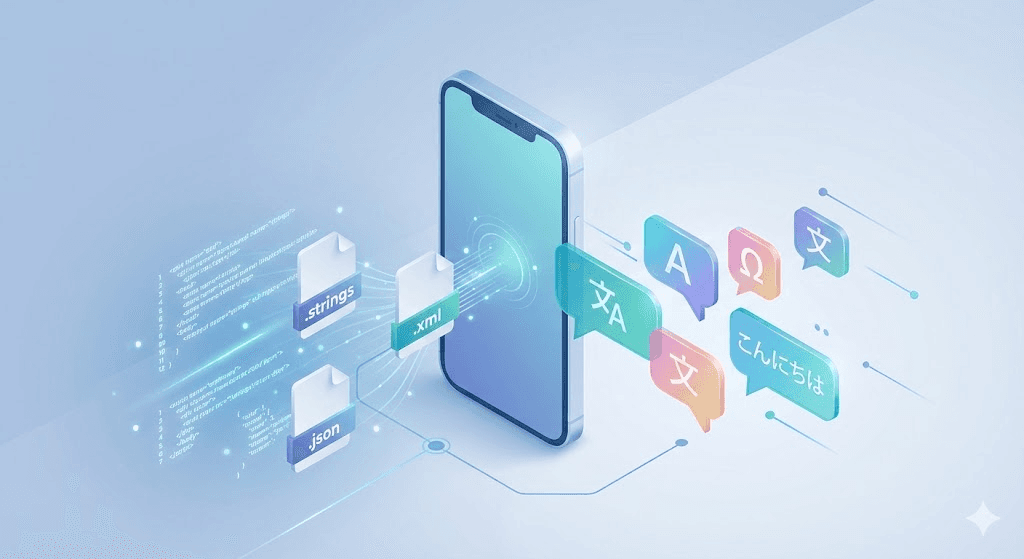
App localization requires strict adherence to operating system standards. We work directly with your development team’s resource files to ensure a seamless build.
iOS & Android Resources
Stop manually extracting text. Send us the raw resource files.
iOS:
.strings,.xliff
Android:
.xmlCross-platform:
.json,.arb(Flutter)
App Store Optimization (ASO)
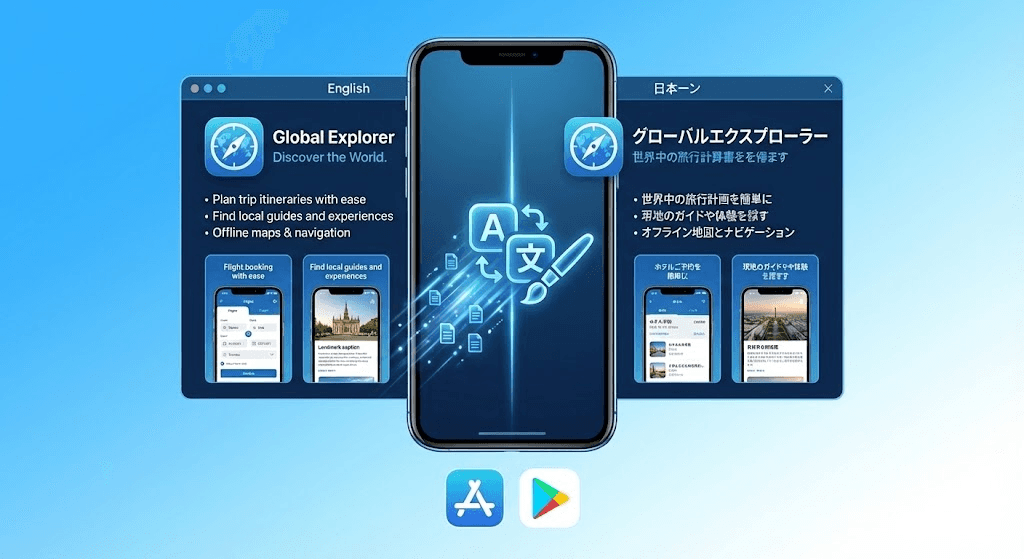
Your app needs to be found before it can be downloaded. We localize your App Store and Play Store listings, including:
App Title & Subtitle: Adjusted for local search volume.
Descriptions: Rewritten to highlight features that matter to that specific culture.
Screenshots: We translate the text inside your promotional screenshots.
Automate Your Localization
Connect your CMS or repo. We detect new strings, translate them, and push them back, no manual exports or copy-pasting.
Engineering Specifics
Translation often fails when it ignores the logic inside your application. We address the specific engineering challenges that cause bugs during localization.
Variable & Placeholder Protection
Your code uses placeholders like {username} or %s. A standard translator might accidentally translate or delete these, causing your app to crash. We protect these strings using regex, so linguists can move the variable to fit the grammar, but cannot edit the code itself.
Complex Pluralization Logic
English has two forms (singular/plural). Russian has three; Arabic has six. We adapt your ICU Message Formats or string files to support language-specific plural rules, ensuring you don’t display grammatically incorrect messages like "5 file(s)" to global users.
UI Mirroring (RTL Support)
For Arabic, Hebrew, or Urdu, simply aligning text to the right is not enough. We advise on full UI mirroring—flipping back arrows, progress bars, and navigation menus to match the reading direction of the user.
Font Compatibility
If your brand font lacks Chinese or Cyrillic glyphs, users will see empty squares (known as "tofu"). We identify necessary font fallbacks or Google Noto integration to ensure characters render correctly.
Step 1: Code Parsing (File Protection)
We extract translatable text while locking executable code. Our system separates content from tags (like <div> or {variable}), ensuring the AI or linguists never touch the site architecture.
Step 2: AI-Accelerated Translation
Your content is processed through our domain-specific Neural Engines. This provides an immediate, high-accuracy first draft, ensuring terminology consistency across thousands of pages instantly.
Step 3: Human Expert Review (Post-Editing)
AI understands words; humans understand context. Our native editors review the AI output to fix nuance, tone, and cultural relevance. They ensure a "Bank" is a financial institution, not a river edge, and that the tone matches your brand voice.
Step 4: Pseudolocalization (Layout Stress Test)
Before delivery, we run a "dummy test" by expanding text length (e.g., by 30%) to simulate languages like German. This catches broken buttons or overlapping text before you deploy.
Our "Hybrid" Methodology Workflow
We use a specific technical workflow to ensure that adding a language doesn’t break your site’s layout or functionality.
Pre-Translation Source Code Audit
Before the project begins, we can perform a health check on your files to identify issues that will slow you down later:
Concatenation Detection
We flag instances where developers have split sentences into parts in the code (which makes translation impossible due to word order changes).
Hard-Coded String Review
We scan your source code to find text buried in Javascript or PHP files that hasn't been externalized.
Encoding Verification
Ensuring all files are UTF-8 compliant to prevent character corruption.
Technical Specifications
File Formats We Support:
WEB
HTML, XML, PHP, CSV, JSON, PO/MO
MOBILE
.strings, .xml, .xliff, .rrc
DESIGN
IDML (InDesign), Illustrator, Sketch, Figma exports
Frequently Asked Questions
How does AI + Human translation differ from just using Google Translate?
Will using AI translation hurt my website’s SEO ranking?
Can you translate my website without giving you backend login access?
4. How do you handle code variables and placeholders during translation?
What is the turnaround time for a 10,000-word website using the Hybrid model?
Do you support "Continuous Localization" for weekly updates?
Is my source code safe if I send you JSON or PHP files?
Can you handle Right-to-Left (RTL) languages like Arabic and Hebrew?
How much cheaper is the AI + Human approach compared to traditional translation?
What happens if the translated text breaks my website’s design?
Still have questions?

Contact us
Get a Custom Quote


Our support is available to help you 24 hours a day, seven days a week.
Call Us : 201-598-1767
Email : information@datagainservices.com
Address : 10750 Moore Drive, Parkland, FL 33076
Services
Integrations